
Hello, I am Naipunnya Raj from the Quantum team at Fujitsu Research India Private Limited (FRIPL).
Quantum Autoencoders (QAE) are excellent at compressing quantum states, but what if we could also make them generate entirely new quantum states? In our recent work, we propose the Quantum Generative Adversarial Autoencoder (QGAA), a model that does exactly this by training a Quantum Generative Adversarial Network (QGAN) on the compressed latent space of a trained QAE. We validated this on entangled state generation and molecular ground state energy profiling for and
, achieving energy errors as low as
. In this post, we walk through the core idea, the key results, and what this means for practical quantum machine learning.
- The Gap: Compression Without Generation
- The QGAA Architecture
- Why This Design Works
- Application 1: Generating Entangled States
- Application 2: Molecular Ground State Generation
- Practical Takeaways
- Limitations and Open Challenges
- Summary and Outlook
The Gap: Compression Without Generation
A QAE learns to compress quantum states into a lower-dimensional latent space and reconstruct them with high fidelity. It has been applied to quantum simulation, denoising entangled states, and error mitigation on NISQ devices.
However, the QAE has a fundamental limitation: it cannot generate new quantum states from its latent space. The latent representation is learned, but there is no mechanism to sample from it. In classical machine learning, the Variational Autoencoder (VAE) solves this by regularizing the latent space with a known distribution. In the quantum setting, no such straightforward analogue exists.
This is the gap QGAA is designed to fill.
The QGAA Architecture
QGAA works in three stages.
Stage 1: Compress with QAE
We train a QAE to encode input quantum states into a compact latent register. The encoder is a parameterized unitary that maps an -qubit state into an
-qubit latent subspace plus an
-qubit "trash" subsystem. Tracing out the trash yields the compressed latent state. The decoder reverses this process using a fresh auxiliary register. Training minimizes a fidelity-based loss between original and reconstructed states.
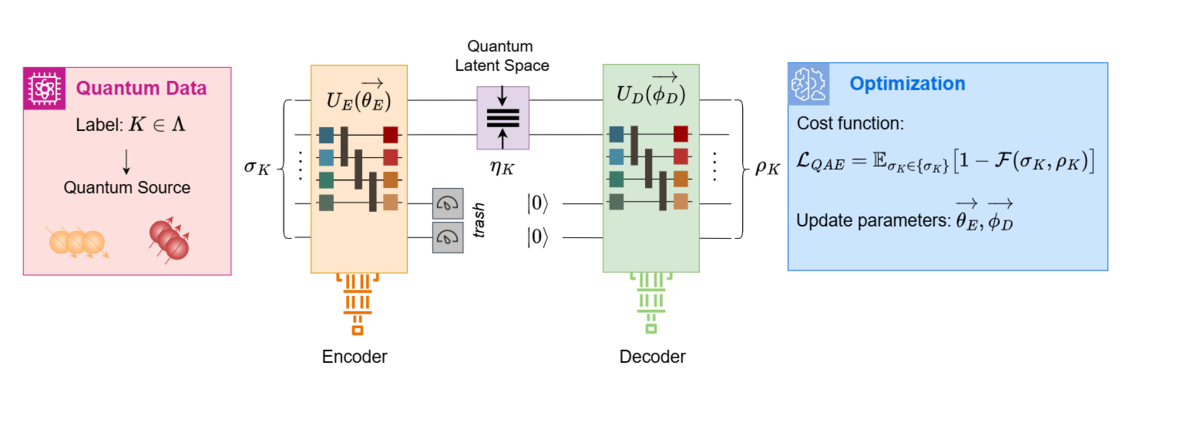
compresses input quantum states
into a latent representation
by tracing out the "trash" qubits. The decoder
reconstructs the output state
. Training minimizes the fidelity-based loss between
and
. While this achieves effective compression, the latent space cannot be directly sampled for generation.
Stage 2: Learn the latent space with QGAN
After QAE training, we freeze the encoder and decoder parameters and train a QGAN to learn the distribution of latent states . The QGAN consists of:
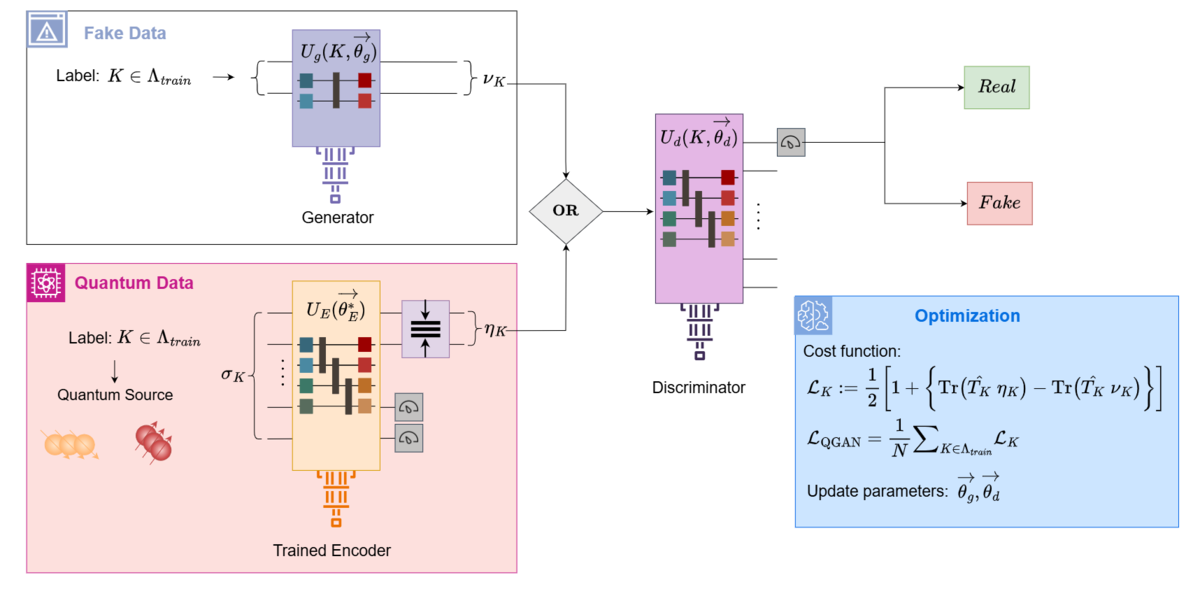
from the frozen trained encoder serve as "real data" for the QGAN. The generator produces "fake" latent states
conditioned on the same labels. The discriminator learns to distinguish real from fake, while the generator learns to fool the discriminator. At convergence,
for all training labels.
Generator: a parameterized quantum circuit that produces candidate latent states conditioned on label information.
Discriminator: a quantum circuit with a probe qubit that distinguishes real latent states, from the encoder, from fake ones, from the generator.
Through adversarial min-max optimization, the generator learns to produce latent states indistinguishable from the real ones.
Stage 3: Generate new quantum states
Once trained, the generator can produce new latent states for any label , including labels never seen during training. These are decoded through the trained QAE decoder
to yield new full-size quantum states.
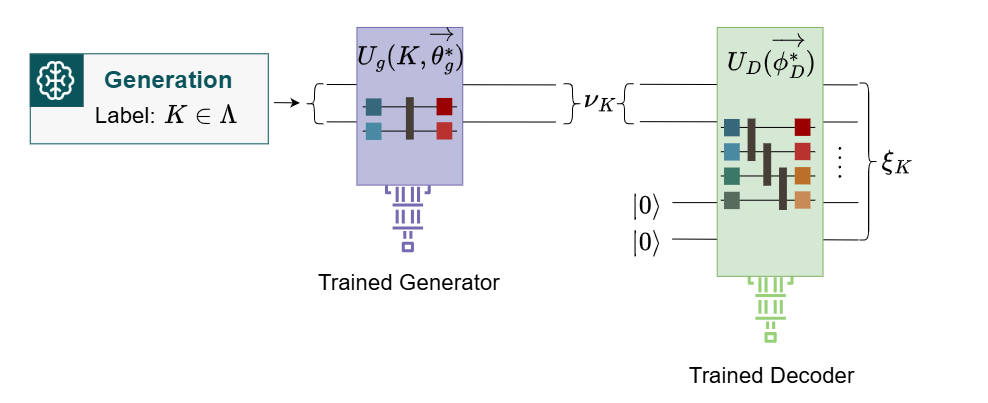
directly produces latent states
for arbitrary label
, including labels outside the training set. These are passed through the trained decoder
to yield generated quantum states
in the original Hilbert space. This is the key capability that QAE alone does not have.
Why This Design Works
The combination provides a bidirectional advantage:
| Component | Without QGAA | With QGAA |
|---|---|---|
| QAE | Compresses only | Compresses and generates |
| QGAN | Trains on full state space (expensive) | Trains on compressed latent space (cheaper) |
Compression makes generation easier. Generation makes compression more useful.
Application 1: Generating Entangled States
As a first demonstration, we prepared a family of parameterized 2-qubit entangled states and trained the QAE to compress them to 1 qubit. After compression, the latent states lie on the surface of the Bloch sphere. We trained a QGAN to learn this 1-qubit latent distribution.
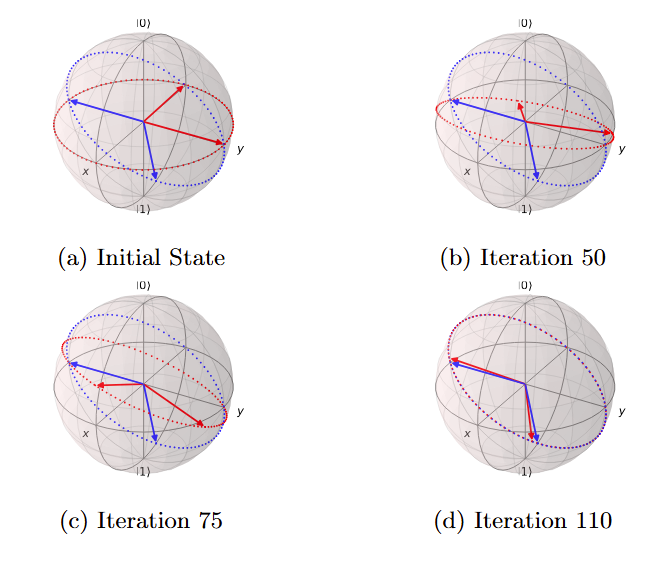
The generator's output converges toward the target latent states, confirming that adversarial learning successfully captures the compressed quantum distribution, including for label values not seen during training.
Application 2: Molecular Ground State Generation
This is where the practical value becomes concrete. We applied QGAA to generate the ground state energy landscape for two molecules, , compressed from
qubits to
, and
, compressed from
qubits to
.
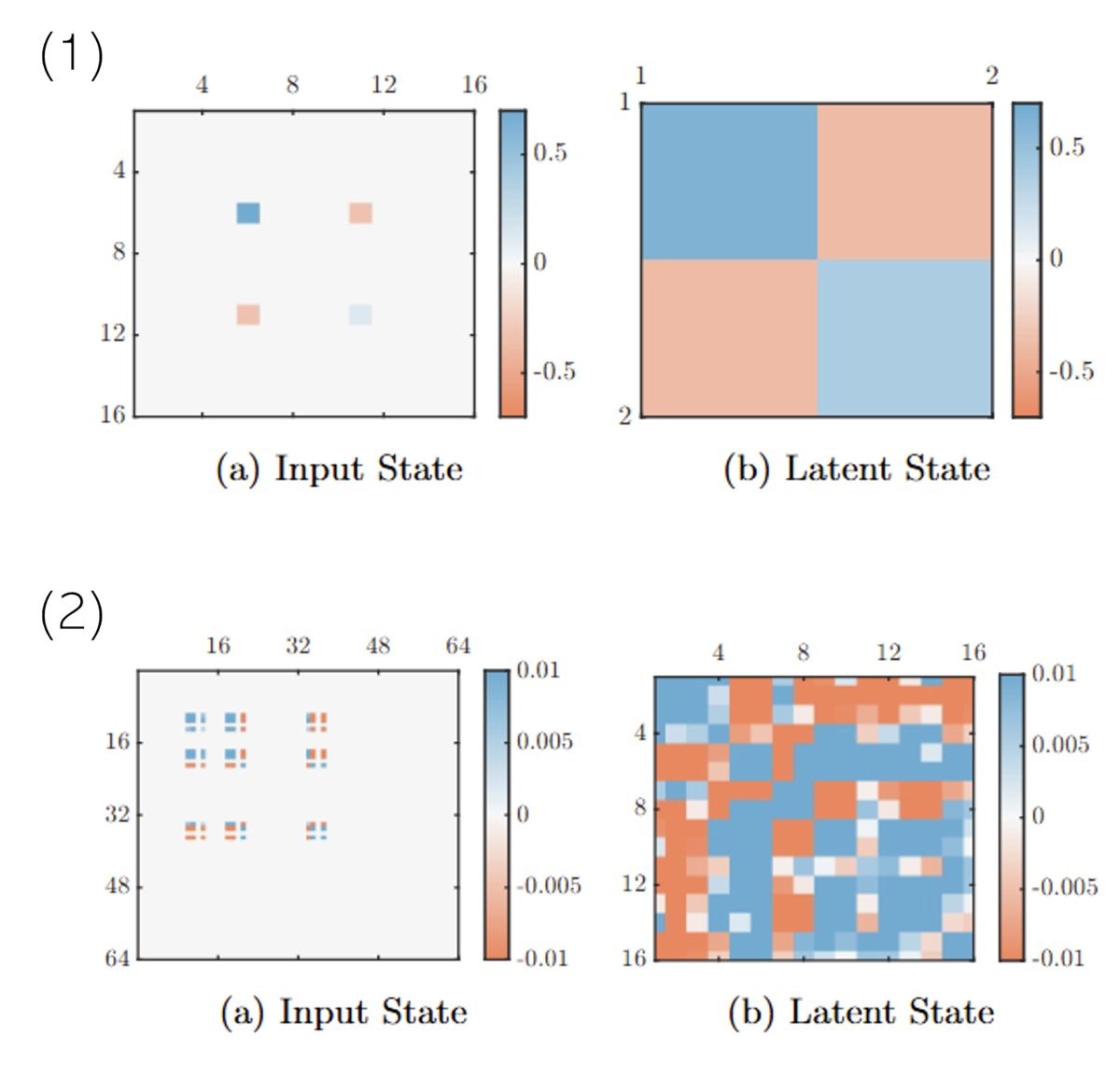
(1)
: 4-qubit
matrix compressed to 1-qubit
. (2)
: 6-qubit
matrix compressed to 4-qubit
. The sparsity of the ground states makes aggressive compression feasible.
QAE Compression Results
| Molecule | Compression | Avg. Fidelity | Avg. Energy Error |
|---|---|---|---|
After adversarial training on the compressed latent spaces, the QGAN generates energy profiles, including for interatomic distances not in the training set.
QGAN Generation Results
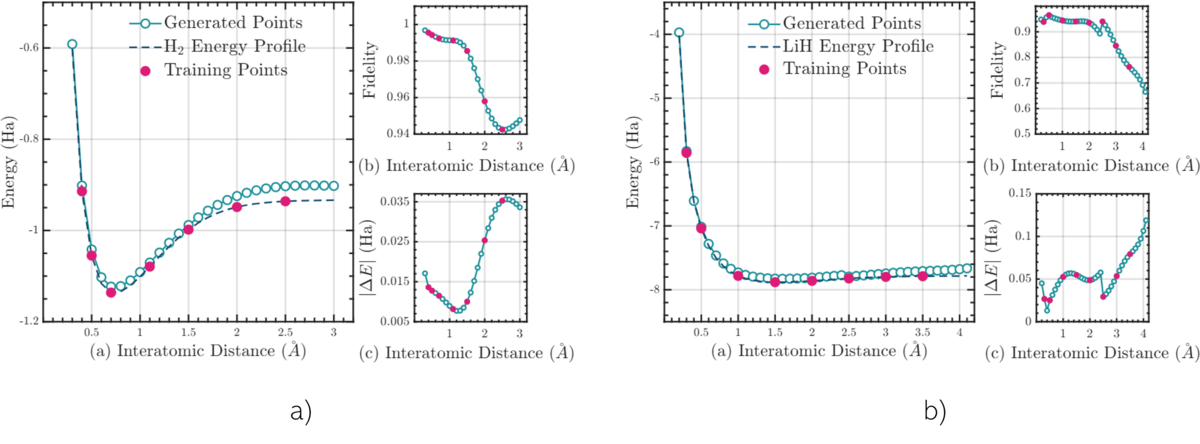
and (b)
. Red points indicate the training data for the QGAN. The average fidelity of generated states is
for
and
for
. In each sub-figure, panel (b) shows the fidelity and panel (c) shows the absolute energy error of the QGAN-generated states.
| Molecule | Avg. Fidelity | Avg. Energy Error |
|---|---|---|
Practical Takeaways
- Compress first, then generate. Training a generative model in a compressed latent space is cheaper and potentially more stable than training in the original space.
- Warm-starting variational algorithms. Even approximate generated states can serve as useful initial guesses for VQE, potentially accelerating convergence.
- Modular design. The QAE and QGAN are trained separately, so each component can be independently improved or replaced.
- Resource awareness. For near-term devices with limited qubits, working in a compressed space is not just convenient, it may be necessary.
Limitations and Open Challenges
- Scale: The largest experiment is 6 qubits. Vanishing gradients and fidelity estimation cost are barriers to scaling.
- Training stability: Adversarial convergence is not always straightforward in practice.
- Hardware: All results are noiseless simulations. Real-device noise remains open.
Summary and Outlook
QGAA turns a compression-only Quantum Autoencoder into a generative model by training a Quantum GAN on its latent space. We demonstrated this on entangled states and molecular ground states, and
, achieving energy errors as low as
. By generating in a compressed space, quantum state generation becomes both more accessible and more resource-efficient.
For full details: arXiv:2509.16186
