

Hello everyone, this is Hiroyoshi Ohtsu from the Device & Materials Research Center.
In early October, the Nobel Prizes were announced, and we had the delightful news of Japanese researchers winning double awards in Physiology or Medicine and Chemistry. The Nobel Prize awarding ceremony was just few weeks ago, so it's still fresh in our minds. News of the Nobel Prizes is incredibly encouraging researchers like myself who aspire to advance science and technology. Professor Susumu Kitagawa (Kyoto University), one of the pioneers of a material called MOF, was selected for the Nobel Prize in Chemistry.
In this article, I, who have been researcher of MOFs (Metal-Organic Frameworks, pronounced "moffs") for the past decade, will introduce this material that garnered the Nobel Prize in Chemistry. Among the vast array of materials, why was MOF chosen for such an honor?
What is MOF?
MOF is a type of material, referring to structural entities formed by the combination of metal ions and organic compounds (called ligands). As shown in the figure below, MOFs usually adopt a crystalline structure where this combination of metal ions and organic ligands is periodically arranged in three dimensions. A notable characteristic of this material is that it often possesses 'pores'. The left side of the figure below is a schematic diagram of a MOF, and the right side shows an example of the actual MOF formation process (on the example of typical MOF, so-called MOF-5). As shown on the left side of the figure, with metals or metal clusters at each vertex and organic ligands along the edges, the structure assembles like an architectural edifice.
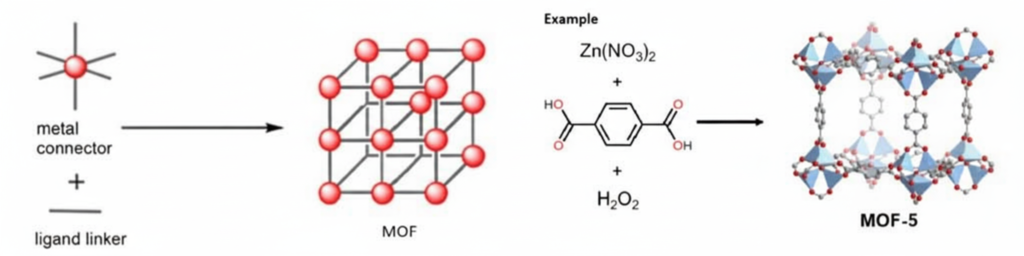
Then, as you can see from the arrangement in the figure, gaps are created, which become pores. Professor Susumu Kitagawa made an analogy of this to the Kiyomizu-dera Temple stage (Kiyomizu no Butai) shown in the photo below, aptly describing its architectural form. The Kiyomizu-dera stage also has gaps in its intricate wooden framework. MOFs have essentially this concept at a molecular level. This means these molecular-sized pores are precisely the moderate size to accommodate carbon dioxide and other small molecules. Therefore, MOFs possessing pores are sometimes referred to as Porous Coordination Polymers (PCPs). The term PCP was named by Professor Susumu Kitagawa's group.

A great advantage of MOFs is their flexible designability. The possible combinations of metal parts and organic ligands (organic molecules) are incredibly numerous allowing us to create MOFs tailored to desired functions (purposes). In fact, a database of MOF materials has been created, containing over 40,000 registered types of MOFs.
Are MOFs really that amazing?
Why have MOFs attracted so much attention, enough to merit a Nobel Prize? It's because they represent a new class of materials capable of manipulating gases. As mentioned earlier, MOFs have pores, which allow them to encapsulate gases. This means they can serve as gas storage materials. What's remarkable about MOFs is their gas storage performance; approximately 1 gram of MOF can store gas volume equivalent to the area of 60 tennis courts. This is something that other porous materials like zeolites cannot achieve. Consequently, various applications are conceivable, such as storing and transporting gases, and chemically converting stored gases. In essence, MOFs allow us to freely control gases. Because MOFs represent such a material system with a novel concept, they were likely selected for the Nobel Prize.
What is MOF useful for?
As such, MOFs are key materials for manipulating gases. Professor Susumu Kitagawa famously said, "Air is gold," in his Nobel Prize lecture. MOFs play a role in valorizing air because they can effectively capture elusive substances ubiquitous in the atmosphere. That is, they can capture CO2 and water from the air, turning them into resources. Hence, "air is gold."
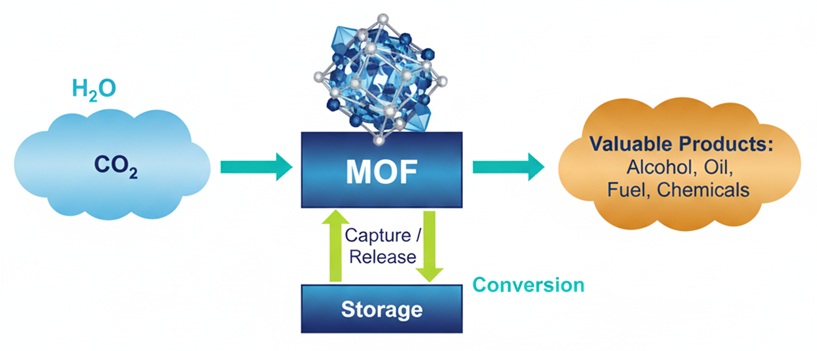
Specifically, MOFs can be used to collect carbon dioxide (CO2), a greenhouse gas, from the air. Although CO2 constitutes only 0.04% of the air, a small proportion compared to other gases, MOFs can be engineered to capture CO2 even from such dilute concentrations. Furthermore, if MOFs are used as catalysts, CO2 can be converted into valuable products like petroleum or alcohol. MOFs can also be used for water harvesting. While water scarcity is a severe problem in desert regions, MOFs can collect water from low-humidity air typical of deserts. This means water can be generated in waterless deserts. This could be a groundbreaking solution to water shortages. The concept is illustrated in the figure below, demonstrating MOFs' high potential in various applications.
MOFs also have many environmental applications, including the removal of PFAS and toxic substances. Furthermore, various applications are being explored, such as drug delivery systems and environmental sensors.
Moreover, since MOFs themselves possess beautiful crystalline structures, they can be used analytically. For instance, non-crystalline substances (like liquids) can be incorporated into MOFs to elucidate their molecular structures. This approach, known as the "Crystalline Sponge Method," has been actively researched by Professor Makoto Fujita at the University of Tokyo in recent years. I personally conducted research in this area in the past.
Professor Susumu Kitagawa's Research
Professor Susumu Kitagawa was awarded the Nobel Prize for advancing the structural design of MOF materials and demonstrating their ability to store and release gases within their pores. Of the other two Nobel laureates in Chemistry this year, Professor Richard Robson is recognized as the proposer of MOF's potential, and Professor Omar Yaghi as the pioneer of stable and rigid (static) MOFs. Professor Kitagawa, in contrast, pioneered soft and dynamic MOFs. He has researched MOFs that not only exhibit interesting structural changes in response to gases but also have practical utility, such as releasing gases only when needed. Professor Kitagawa initially conducted research in the field of coordination chemistry. On a personal note, during his tenure as president of the Japan Society of Coordination Chemistry from 2012 to 2016, I was engaged in research on unstable species within MOF crystals. It was a great honor that Professor Kitagawa and his colleagues showed interest in my work at academic conferences.
MOF Research and Fujitsu's Research
Now, MOF research itself is materials research, but it is not unrelated to the research conducted at Fujitsu. As mentioned earlier, since MOFs are composite materials made of metal ions and ligands, the number of potential new MOF materials is enormous due to combinatorial explosion. Therefore, it is impossible to experimentally synthesize and screen all of them. This makes MOFs highly suitable for Materials Informatics (MI) methods, which combine databases and calculations to narrow down candidate materials with desired functions, a task previously reliant on intuition. Furthermore, due to the difficulty of material exploration caused by combinatorial explosion, MOFs are also targets for material exploration using quantum computers. This is not only because MOFs involve combinatorial explosion, but also reflects the high expectations for MOF's functions and the desire to maximize their potential through material exploration. In this way, MOF research, in its focus on materials, has a connection to the research at Fujitsu.
Conclusion
Although MOFs are still a new material entering the market, it is expected that they will become more widely adopted following this Nobel Prize. The positive role played by MOFs, a novel material system, in environmental solutions will undoubtedly continue to develop further. This thought re-emerged when I watched the news of the Nobel Prize awarding ceremony.
Related Articles
MOFs are classified as one type of coordination compounds. I have attached an article I introduced last year about the Japan Society of Coordination Chemistry. Professor Susumu Kitagawa was the 10th president of the Japan Society of Coordination Chemistry. Please refer to it.
