
Hello, I am Hannes Leipold from the Quantum Applications CPJ team at Fujitsu Research of America (FRA). This blog post summarizes some of our recent work with Steven Kordonowy, which was presented at APS March Meeting 2025, Quantum Techniques in Machine Learning 2025, and Fujitsu Quantum Day 2026 as well as published in npj Quantum Information) in February 2026.
As part of our quantum efforts at FRA, we focus on the training and design of Variational Quantum Algorithms (VQA) and quantum neural networks (QNN) for applications, such as optimization tasks in finance. Recently, our paper on designing a warm starting protocol for the Quantum Alternating Operator Ansatz (QAOA), which is a popular VQA, was published in npj Quantum Information. In this blog post, we focus on the high level problem we considered and what solution we provided to this problem in the domain of training QAOA for Portfolio Optimization, which is an important optimization task encountered in finance.
Variational Quantum Algorithms
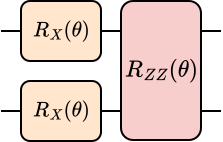
Parameterized Quantum Circuits (PQCs) are quantum circuits that have free parameters associated with the individual gates or some collection of gates on the device. Similar to the structure of simple neural networks, PQCs are often a simple repeated block structure, with each block having a set of specific gates. For example, we may apply a rotational x-gate (Rx) on qubit 1 and another on qubit 2. We then may apply a rotational ZZ gate (Rzz) that couples qubit 1 and qubit 2. Each of these rotation gates can be parameterized by $\theta_1$, $\theta_2$, and $\theta_3$ respectively. Then using Quantum Machine Learning (QML) techniques, we can train these parameters to optimize the circuit for a given loss, for example to prepare a ground state of some two qubit Hamiltonian.
The following diagram depicts this two qubit three gate PQC.
VQAs leverage PQCs to solve some algorithm task at hand, similar to how some classical algorithms may utilize neural networks to solve some task. An important task then becomes how to design PQCs for tasks that we wish to use VQAs for and how to appropriately train the PQC. QAOA is a popular and robust VQA to solve optimization tasks.
The Dynamic Lie Algebra (DLA) and its Impact on Trainability
The training landscape of a VQA is described by the dynamic Lie algebra (DLA) of the quantum circuit. The DLA describes the expressivity of the quantum circuit, the space of possible unitary rotations that the quantum circuit could potentially implement. If the quantum circuit can express more unitary rotations, it has the ability to be utilized for more general types of problems. A very general quantum circuit, such as the hardware efficient ansatz, can express an exponential space of potential unitaries, and this expressiveness is closely tied to important forms of quantum advantage, such as that of Random Circuit Sampling. However, the parameters of the circuit may need to be finely tuned to express the optimal such unitary rotation to accomplish the task at hand when used to solve some optimization task. This leads to a Barren Plateau, where the gradients of the PQCs for most loss functions exponentially vanish. This leads to poor trainability that prevents VQAs from finding good quality solutions to optimization tasks, especially if the circuit is large in width (the number of qubits) and depth (the number of gates).
Optimization problems can come in two flavors, constrained and unconstrained. For unconstrained optimization, we simply find the very best solution of all possible configurations while the constrained version requires us to find the best solution of a smaller set of feasible configurations. By designing the QAOA circuit to preserve the symmetries of the feasible configurations, we can dramatically reduce the dimension of the associated space of configurations that must be considered. However, this leads to more intricate design, since the gates associated with the symmetries are typically more nuanced.
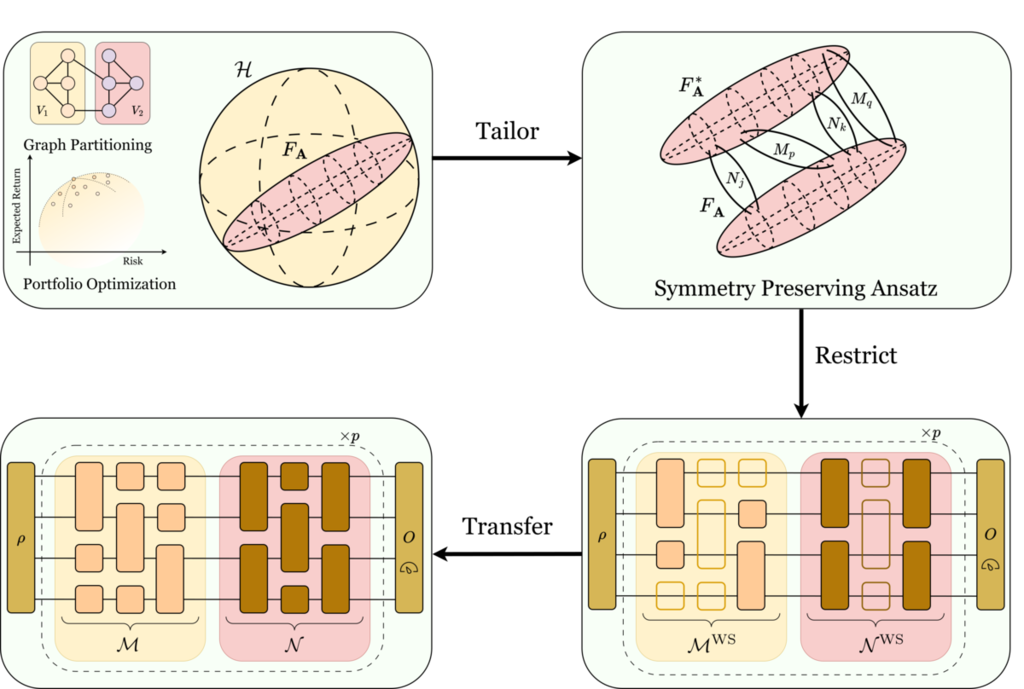
The following diagram depicts how this can inform warm starting for QAOA targeting constrained optimization. Based on the feasible space of interest (top left), the gates of the QAOA are tailored to maintain this subspace (top right), then some of the gates dropped out to pretrain a simpler circuit (bottom right), and then the gates are reintroduced for refinement training with full expressivity (bottom left). Our approach to warm starting QAOA for Portfolio Optimization will follow this general form.
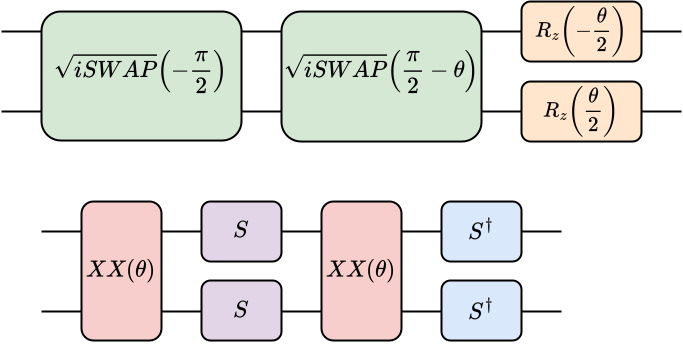
In the case of Portfolio Optimization, the task is associated with a simple global constant constraint that enforces the selection of only a certain number of assets. In this case, the appropriate mixer for the constraint is the $XY$ mixer, which is a simple gate to implement. The following diagram depicts two simple approaches for implementing the XY mixer that are appropriate for near-term devices.
Identifying Subcircuit DLAs and their Warm Starting Potential
Our research focused on analyzing the DLA of QAOA for Portfolio Optimization as well as that of circuits with more restrictive expressibility. We saw that QAOA is plagued by the Barren Plateau phenomenon, but that more restricted subcircuits were not. This led to the main concept for our work: training a restricted subcircuit of QAOA which is highly trainable and utilizing the parameters of this subcircuit to initialize the full QAOA circuit.
The following Venn diagram depicts the overlap of the different Lie algebras that we studied. We labeled the two most important such spaces, the smaller one is the Lie algebra of the pretrain circuit, which has a dimension that grows only quadratically in the number of qubits, while the full QAOA circuit has a DLA that grows exponentially.
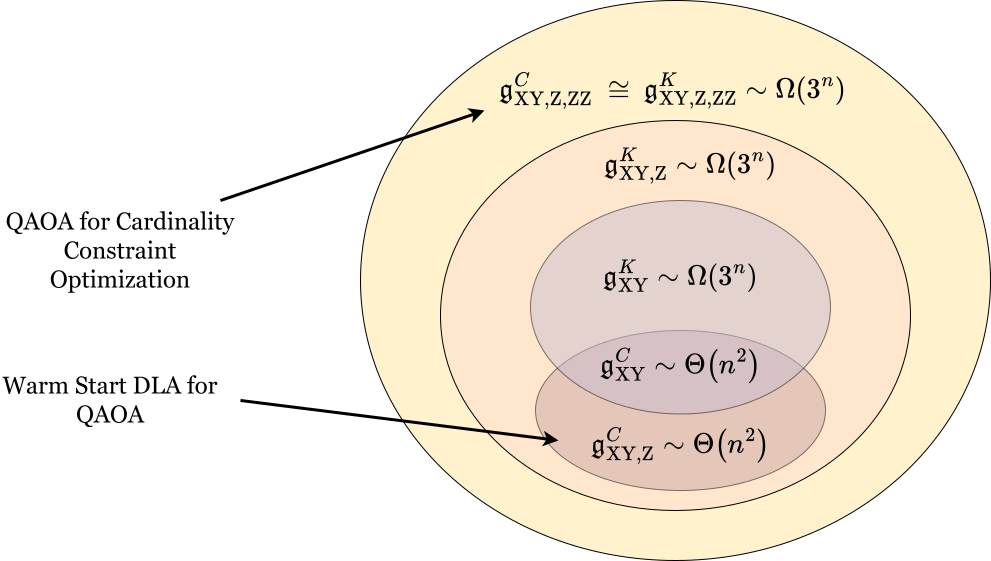
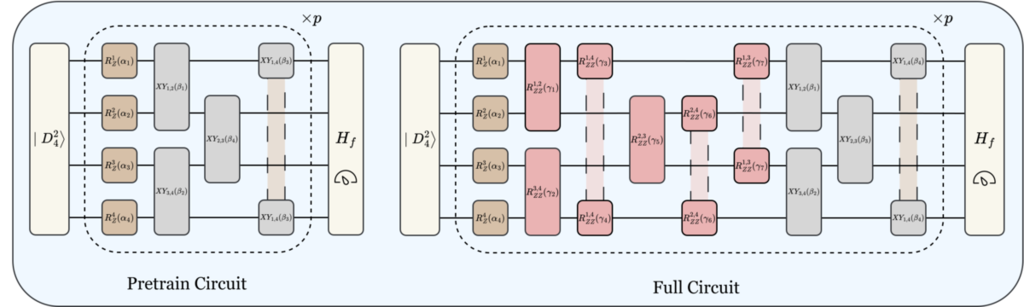
The importance is that the pretrain circuit has a much smaller space of possible unitaries it can represent and is therefore much more trainable, allowing us to utilize it for warm starting the full QAOA circuit because each gate in the pretrain circuit is also found in the full QAOA circuit. The following diagram depicts the pretrain circuit and the full QAOA circuit for Portfolio Optimization that we utilized. Notice that the Rzz gates are there for the full QAOA circuit (shown in red), but are not there in the pretrain circuit. Indeed, the inclusion of the Rzz gates is precisely what leads to the explosion in the expressivity of the circuit.
Portfolio Optimization and Warm Starting QAOA
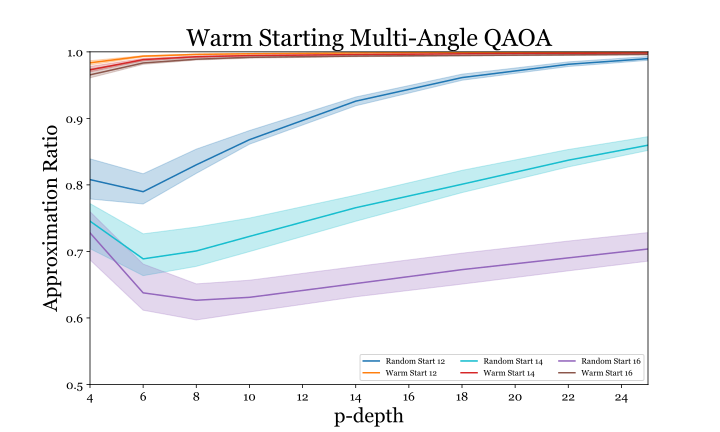
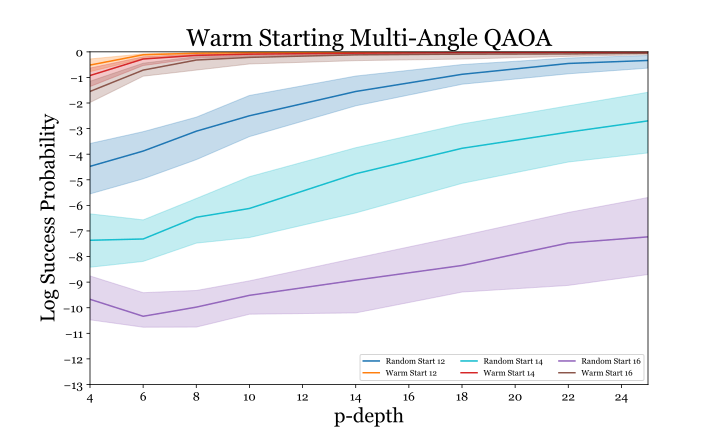
To validate our warm starting method, we trained quantum circuits in the classical simulable regime. Specifically, we trained quantum circuits of varying depth with the number of qubits varying from 12 qubits to 16 qubits.
As the number of qubits grows, the gradients begin to vanish for the QAOA full circuit and we see that the circuit has poor quality parameters after training. The results are shown in the following figures with the colors light blue, blue, and purple. In both the approximation ratio and the success probability, which are two of the most important ways to characterize the quality of the solutions sampled, we see that the QAOA circuit is showing increasingly poor sampling.
In orange, red, and brown we show the respective results for the warm started QAOA circuit in terms of approximation ratio and success probability. We see that the warm started circuit does significantly better for any depth and that this gap becomes more noticeable as the number of qubits grows.
Summary
Training VQAs is a major topic in modern quantum computing. VQAs benefit from being more friendly to near-term quantum devices and can be applied to a large range of important tasks, such as QAOA for optimization in many industrial applications.
However, VQAs like QAOA are often plagued by the Barren Plateau phenomenon, which leads to poor-quality parameters and renders the VQA ineffective for the task at hand. By considering the role of the DLA in describing the training landscape, we identify a valuable subcircuit for QAOA that is highly trainable and can be used to initialize the parameters of the full QAOA circuit. Our results validate that this warm started QAOA significantly outperforms randomly initialized QAOA as the number of qubits grows. Many other industrial optimization tasks could be amenable to a similar warm starting approach, and our training method could be applied on larger-scale quantum devices. For future work, experimental verification on quantum hardware demonstrating this scaling beyond the classically simulable regime would be exciting confirmation of the empirical scalability of our approach.
