
Hello! We are Matsumura, Nishiguchi, and Yamazaki from Fujitsu Research. In our project, we are engaged in research and development of Materials Informatics (MI) with the aim of solving customer challenges related to materials technology.
In this Materials Informatics special feature, we introduce a case study where we utilized the knowledge distillation function integrated into GeNNIP4MD [1], a tool we developed for creating neural network potentials for Molecular Dynamics (MD) simulations. We conducted simulations of all-solid-state battery solid electrolyte interphase (SEI) formation using MD simulations of a solid-solid interface model exceeding 120k atoms, consisting of a solid electrolyte membrane and a negative electrode metal.
The Challenge in All-Solid-State Battery Development: Unraveling the Formation Mechanism of the Solid Electrolyte Interphase (SEI)
In recent years, with the spread of electric vehicles and the expansion of renewable energy adoption, all-solid-state batteries are highly anticipated as a next-generation battery. Because they do not use liquid electrolytes, they are expected to offer numerous advantages such as reduced risk of fire, long lifespan, and high energy density.
However, their development is not easy. In particular, a crucial factor that significantly influences battery performance and lifespan, yet has been complex and difficult to elucidate, is the formation mechanism of the Solid Electrolyte Interphase (SEI). This SEI layer is an extremely thin layer, only a few nanometers thick, formed between the electrolyte and the electrodes. The stability of this layer directly impacts the battery's charge-discharge cycle life and safety. Until now, detailed structural analysis at the atomic level has been a long-standing challenge in all-solid-state battery development.
Against this backdrop, we have successfully developed a groundbreaking technology utilizing AI. This technology enables high-speed and high-precision simulation of large-scale all-solid-state battery interfacial structures exceeding 120k atoms, over long-duration behaviors of 10 nanoseconds. This breakthrough allows us to shed light on the atomic-level formation process of the SEI, which was previously difficult to observe experimentally, and holds the potential to significantly accelerate the practical application of all-solid-state batteries.
The Difficulty of MD Simulations for Interfaces
MD simulations are powerful tools for analyzing materials' atomic-level behavior. However, for complex materials like all-solid-state batteries, it has been extremely challenging to stably simulate large systems consisting of tens of thousands or more atoms over long durations (tens of nanoseconds or more) sufficient for battery operation.
In particular, a "force field" model describing atomic interactions is essential for high-performance simulations. In recent years, force fields using neural networks (NNP: Neural Network Potential), a type of AI, have attracted attention, but they also faced challenges. One was the problem of material structure collapse during simulations of specialized materials like all-solid-state batteries when using general-purpose "public NNP." Another was that graph neural networks (GNNs), typically employed by public NNPs, are slow in computation. For long-duration simulations involving 120k atoms, it would take well over a year of computation time, making them impractical for real-world development.
GeNNIP4MD's "Knowledge Distillation"
This time, by using GeNNIP4MD's knowledge distillation function, we have solved the aforementioned problems of accuracy and computation time, enabling MD simulations of all-solid-state battery interfaces on the scale of 120k atoms over 10 nanoseconds to be executed within a realistic computation time of just one week. Figure 1 shows an overview of GeNNIP4MD's knowledge distillation.
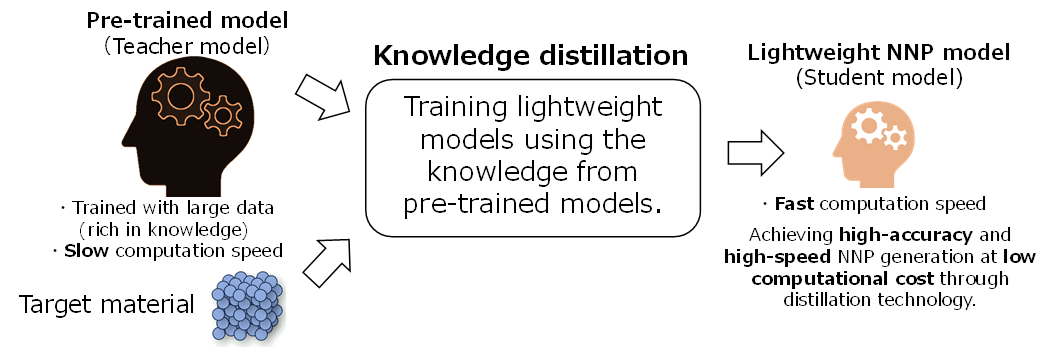
GeNNIP4MD's knowledge distillation efficiently transfers the knowledge of pre-trained machine learning force fields, which are trained on large datasets and publicly available (e.g., open source) as a teacher model, to a lightweight student model. This allows for a reduction in the amount of training data required for the student model compared to training it from scratch. Through this knowledge distillation, it becomes possible to automatically construct a machine learning force field that can describe chemical reactions with high accuracy and enable large-scale, long-duration simulations, which were previously difficult to develop, at a low computational cost.
MD Simulation Results of All-Solid-State Battery Interfacial Model
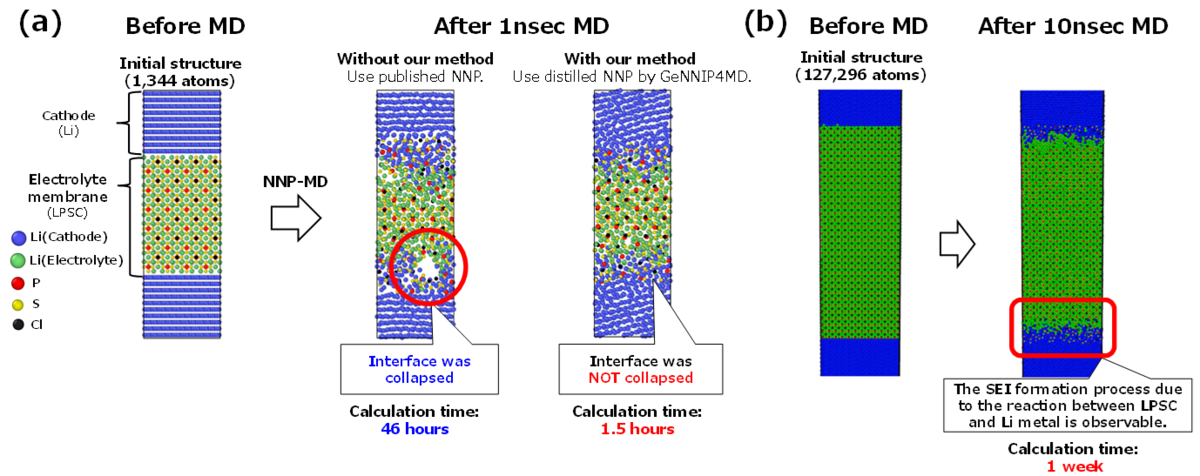
Using the NNP created with the knowledge distillation function described above, we performed MD simulations of an all-solid-state battery solid electrolyte membrane and negative electrode interface model. First, using an interface model of 1,344 atoms shown in Figure 2(a), we evaluated the public NNP and the NNP created with GeNNIP4MD through 1 nanosecond MD simulations. As a result, with the public NNP, the interface structure collapsed, and vacancies occurred. Furthermore, the 1-nanosecond simulation took approximately 46 hours to complete. In contrast, with the NNP created with GeNNIP4MD, stable MD simulations were performed without interface structure collapse. Moreover, the simulation was completed in approximately 1.5 hours.
Next, we created an interface model consisting of 127,269 atoms and performed MD simulations using the NNP created with GeNNIP4MD. As a result, as shown in Figure 2(b), we confirmed that even with an ultra-large-scale structure exceeding 120k atoms, stable, long-duration MD simulations over 10 nanoseconds could be executed within approximately one week of computation time. This achievement enabled the structural analysis of the solid-electrolyte interphase (SEI), which critically affects the performance of all-solid-state batteries, a feat that was previously challenging with experiments or existing MD simulations.
Conclusion
In this article, we introduced a case study where we utilized GeNNIP4MD's knowledge distillation function to reproduce complex chemical reaction processes, such as SEI formation at the interface between the solid electrolyte membrane and the negative electrode of an all-solid-state battery, through large-scale and high-precision MD simulations.
This method allows us to track chemical reactions in interfacial systems exceeding 120k atoms with accuracy comparable to first-principles calculations, which was previously difficult to achieve through simulation. The SEI is a phenomenon that determines the charge-discharge cycle life and safety of all-solid-state batteries, and clarifying its atomic-level formation mechanism and stability factors is highly desired. This technology is expected to enable the analysis of SEI formation processes at the atomic level, which were previously unknown, and accelerate the development of methods for inhibiting SEI formation.
References
[1] N. Matsumura, et al., "Generator of Neural Network Potential for Molecular Dynamics: Constructing Robust and Accurate Potentials with Active Learning for Nanosecond-Scale Simulations.", J. Chem. Theory Comput. 2025, 21, 3832–3846.
Contact us
If you are interested in GeNNIP4MD, please feel free to contact us at the address below.
Contact Information: fj-mi-tech-contact@dl.jp.fujitsu.com Inquiries: We can accommodate various requests such as material requests, technical introductions, and PoC verification (for those who wish to try out the technology or apply it to their own materials).
