Hello. We're Suzuki and Kurume from the Converging Technologies Laboratory. Our research group is developing "Policy Twin" technology that dramatically advances policy-making by local governments and nations.
Have you ever heard the keyword "digital twin"? A digital twin is a general term for technologies that construct and simulate a twin of the real world in a virtual space, and it is utilized in various fields such as manufacturing and smart cities. We went further and developed "Social Digital Twin" 1,2 technologies to reproduce people and society in the digital world and solve social issues. And to further deepen these efforts, we are taking a further step by attempting to digitalize "Policy" itself, which forms the foundation of social design. This is the "Policy Twin" technology we are developing.
This time, we would like to introduce the full scope of this innovative Policy Twin technology and its application in actual municipalities. Aren't you excited that our real society will also evolve into a better one by freely testing policies in a digital space, creating such possibilities for new social design? Please look forward to it!
(NOTE: This article was generated using machine translation.)
Fujitsu's Policy Twin Technology
What exactly is "Policy Twin" Technology?
Modern society faces numerous complex problems that need to be solved, in addition to global issues like climate change, infectious diseases, and natural disasters, such as an aging population and widening regional disparities. This makes the accurate policy-making by national and local governments more strongly demanded than ever. However, its realization is not easy. It is very difficult to calculate the effects of policies in advance, and there are still many cases where we have no choice but to rely on experience and past customs.
To solve these challenges, we have developed "Policy Twin," an evidence-based policy-making support technology3,4. Policy Twin is a new approach that focuses on a series of flows common to many policies, such as "what kind of services to provide to what kind of target audience," and reproduces the policy itself in a digital space.
How does it achieve this?
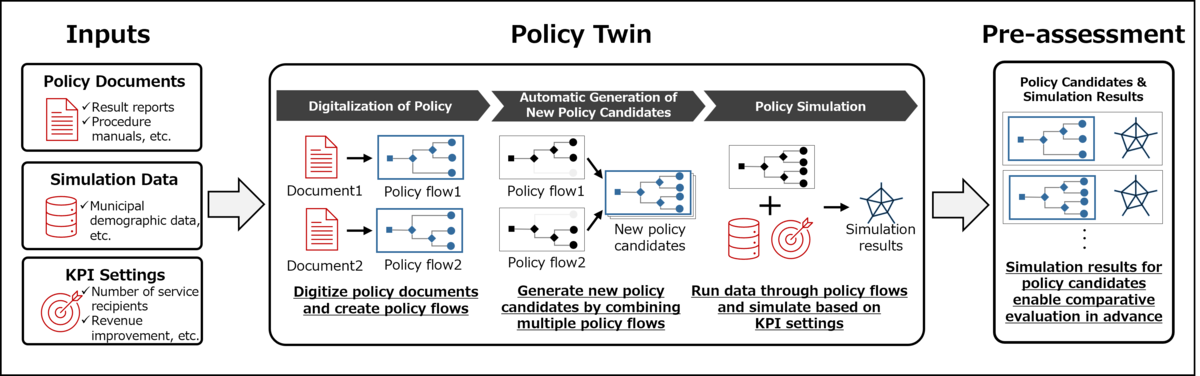
Figure 1 shows the three main processes that Policy Twin possesses. First, existing policies of various countries and municipalities are digitized. By combining these digitized existing policies, new policy candidates that no one had ever thought of are automatically generated. Finally, by considering constraints on limited social resources such as costs and human resources, simulation and evaluation are performed in a digital space, realizing "digital rehearsal" 5 to verify the effects and impacts of policies in advance, and advancing policy-making.
Figure 1: Overview of Policy Twin
Details of Policy Twin Technology
Digitalization of Policies
Here, we will introduce in a little more detail how Policy Twin supports policy-making, including the overall flow and the underlying technology.
Advanced policy-making, which Policy Twin aims for. Its important foundation is the digital conversion of policies implemented in various fields into a "machine-readable format." To efficiently convert the vast number of policies in the world into a machine-readable format, we are developing and applying our own unique technology that uses advanced natural language processing technologies such as large language models (LLMs). This unifies diverse policy document information, which previously varied in format and level of detail, making various mathematical processes possible and opening up new possibilities.
Automatic Generation of New Policy Candidates
Our efforts are not limited to digitizing existing Policies. We have gone a step further and developed a unique algorithm that automatically generates diverse new Policy candidates with excellent "acceptability" and "explainability". By utilizing this algorithm's generation technology, it becomes possible to consider convincing Policies tailored to the specific circumstances of each municipality more smoothly than ever before, without relying on advanced expertise or complex analytical skills.
More Details
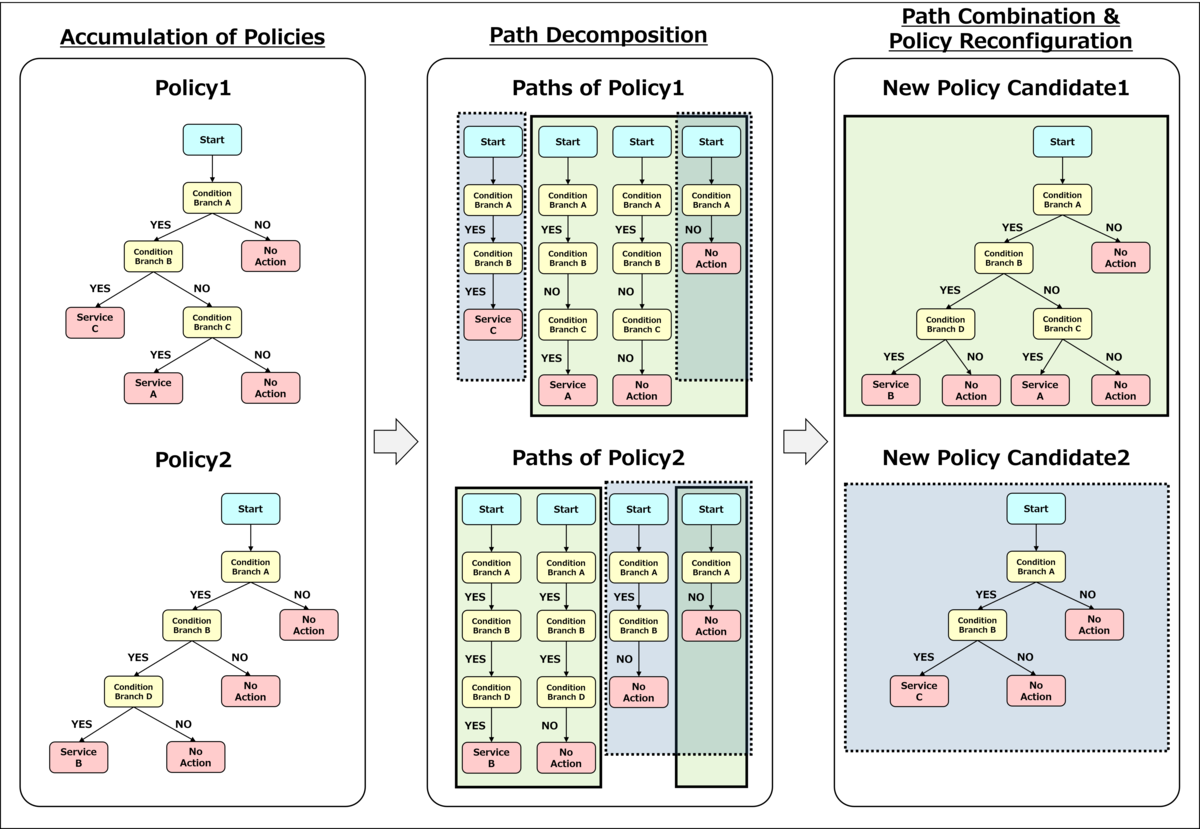
Our developed algorithm is characterized by its deep consideration of relevance to existing Policies and consistency with on-site knowledge and experience. Through this approach, we have pioneered the establishment of a method for automatically generating practical Policies with a view to actual on-site implementation worldwide. Specifically, by breaking down accumulated numerous existing Policies into smaller "constituent elements" and flexibly reconfiguring them, we automatically generate novel and on-site acceptable new Policy candidates based on proven Policies.
Figure 2: Automatic Generation of New Policy Candidates
Processing steps in reference paper 6: By treating policies as decision trees, new policy candidates are generated according to the following procedure. First, as shown in the left of the figure, existing policies such as those implemented in the past or proven policies of other municipalities are accumulated. Policy 1 and 2 correspond to these existing policies. Next, as shown in the center of the figure, the accumulated policies are decomposed into paths from the starting point to each service. The top center shows the set of paths decomposed from Policy 1, and the bottom center shows the set of paths decomposed from Policy 2. Finally, as shown in the right of the figure, combinable paths are searched from the decomposed paths (nodes are searched sequentially in depth from the beginning of the path set, and paths with different Yes/No branches are combined), and new policies are reconfigured by synthesizing them. New policy candidate 1 is generated from the green paths among the decomposed paths, and new policy candidate 2 is generated from the blue paths.
Policy Simulation
"How much effect will this policy candidate actually bring?" Policy Twin provides an answer to this question by performing simulations. For example, data samples representing individual characteristics are fed into the digitized policy flow. This makes it possible to verify in advance the effects (KPIs: Key Performance Indicators) that policies will have on target individuals and organizations. For example, various information useful for policy consideration, such as the number of people reaching each service, the utilization rate of budgets and resources based on that, and even the QOL (Quality of Life) and satisfaction of target individuals, can be obtained as results. Through this simulation, by digitally rehearsing "which policy is most effective" and "what kind of issues may arise" within limited resources, we can support more reliable and efficient optimal decision-making.
Use Cases
How does Policy Twin actually help?
This time, to verify the effectiveness of the Policy Twin we developed, we collaborated with a certain municipality and applied the technology using actual policies.
On-site Challenges and Expectations for Policy Twin
The theme of this time is prevention of severe disease progression, which is a very important societal issue. Among them, we focus specifically on policies to prevent the severe progression of diabetic nephropathy, which has many patients as a lifestyle-related disease in Japan. Diabetic nephropathy, if it progresses, requires dialysis therapy, which not only significantly impairs the QOL of patients but also increases the national medical expense burden. In such a situation, local governments nationwide are implementing policies to "early identify high-risk patients, provide appropriate health guidance, and reduce/prevent the risk of artificial dialysis." However, the target municipality faced the challenge of "the number of people receiving health guidance is not increasing as expected, and we don't know how to change the policy content."
Therefore, we verified how Policy Twin could solve this problem. We challenged ourselves to propose new policies that would improve policy effects, including the number of people receiving health guidance, by maximizing limited budgets and resources.
Steps of Technology Application
This time, we digitized policies related to the prevention of severe diabetic nephropathy, automatically generated new policy candidates, and simulated their effects.
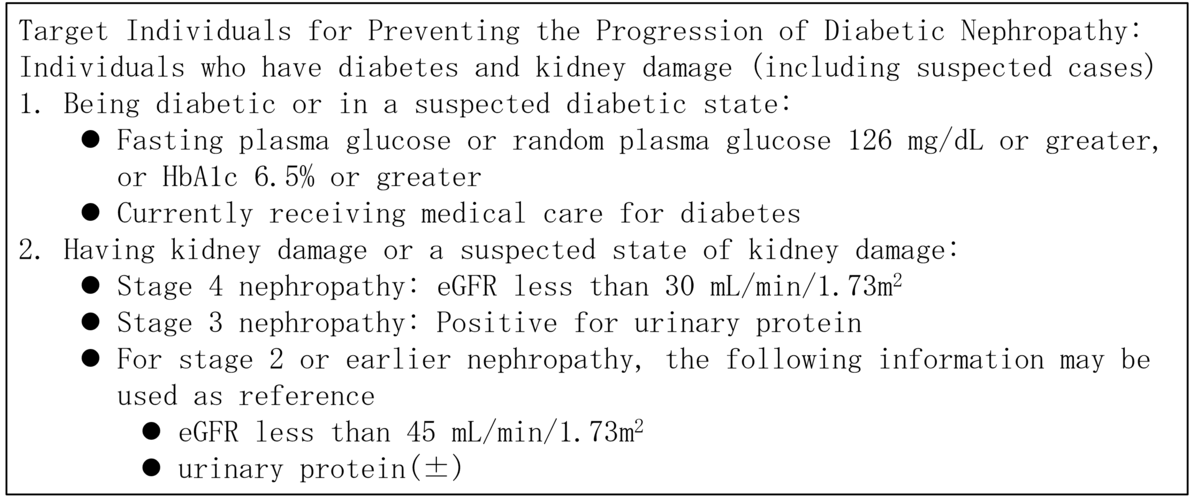
Let's look at the image of the digitized policy flow. Figure 3, simplified, shows a general guideline for this policy. In this guideline, "high risk of severe diabetes progression" and "high risk of severe kidney disorder progression" are the main extraction criteria for determining target individuals for health guidance, which are determined based on health checkup values. The thresholds and combinations of these extraction criteria are not uniform, as they are uniquely set according to the individual circumstances of each municipality.
Figure 3: Diabetic Nephropathy Intervention
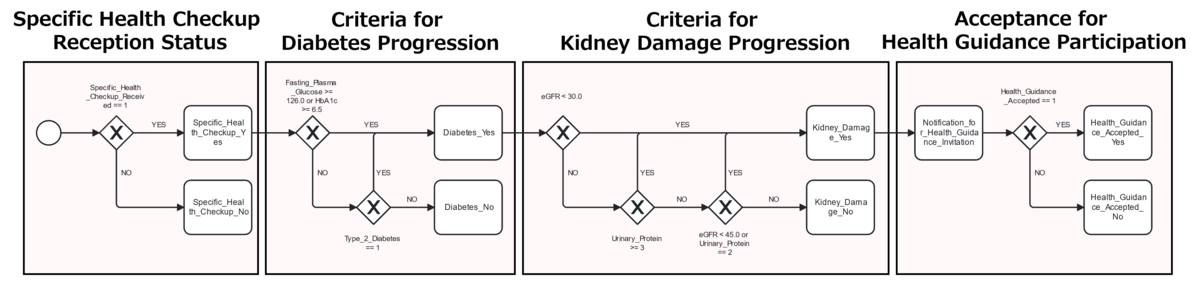
The digitized policy flow is as follows (Figure 4). This policy flow consists of the following four main elements:
Figure 4: Policy Flow
Specific Health Checkup Reception Status: Extract target individuals who have undergone specific health checkups.
Criteria for Diabetes Progression: Extract target individuals at high risk of severe diabetes progression.
Criteria for Kidney Damage Progression: Extract target individuals at high risk of severe kidney disorder progression.
Acceptance for Health Guidance Participation: Notify target individuals about health guidance and confirm their acceptance.
We created such policy flows for the target municipality and 15 other cities. By combining these as input, we generated about 100 diverse policy candidates. In addition, to evaluate these policy candidates from various perspectives, we performed simulations using multiple important KPIs (medical expenses, health improvement effects, execution costs of recommendation notifications, etc.) and selected the optimal policy among the generated policy candidate group that matched the specific circumstances and goals of the target municipality.
As a result, this policy candidate was shown to be expected to bring improvements in multiple KPIs compared to existing policies, while satisfying limited resource constraints. Specifically, it became clear that although execution costs would increase slightly, medical expense cost savings and health improvement effects that would exceed it could be expected.
The Potential of Policy Twin Seen from the Application Results
What good things will happen if this Policy Twin is put into practical use?
By leveraging Policy Twin, it becomes possible to formulate policy candidates that improve effectiveness while satisfying resource requirements, as described above. This has the potential to significantly improve policy-making operations, which have often relied on experience and past customs. This time, local government officials and experts have evaluated Policy Twin as having great potential in the following areas. We will introduce the main evaluation points and the new value that Policy Twin brings.
Contribution to Business Efficiency
In the field of municipal policy-making, it is difficult to pass on experience and knowledge due to changes in personnel. Policy Twin addresses this by presenting evidence-based policy proposals, thereby supporting everyone to conduct high-quality policy-making efficiently, regardless of the experience of the person in charge. Furthermore, because policies are digitized and structurally visualized, it is expected to significantly improve the efficiency of information gathering operations currently performed on-site, such as searching for and referencing information on successful cases from other municipalities. Moreover, the effect of sharing excellent policies and spreading them throughout regional society can also be expected.
Promotion of Evidence-Based Policy-Making and Consensus Building
Policy Twin can show the rationale for policy proposals, such as "which specific municipality's policies were referenced to automatically generate the policy," and KPIs calculated based on the track records of past municipalities. Since these results are very easy to understand and highly convincing, we have heard that it fulfills accountability to stakeholders and promotes smooth consensus building.
Future Plans
The application to the prevention of severe diabetic nephropathy introduced this time is just one aspect of the potential of Policy Twin. In the future, we plan to continue refining the technology to contribute to solving a wider range of social issues, including other policies in preventive medicine. The demo of Policy Twin is currently available on the Fujitsu Research Portal, so please feel free to access it. We would be delighted to consider the future of new social design with all of you using this Policy Twin technology!
At the Converging Technologies Laboratory, researchers with expertise in various fields, including humanities and social sciences, gather and advance research and development by combining their knowledge. Our researchers make new discoveries every day, which is very exciting. The entire team will continue to deliver timely information as we further evolve Policy Twin, so please look forward to it!
Social Digital Twin: Group of technologies to digitally recreate not only the states of both people and objects, but also economic and social activities, based on real-world data. The Social Digital Twin aims to facilitate the understanding of the mechanisms that cause societal problems and solve increasingly complex and diverse issues.↩
Presented at the 2025 Annual Conference of the Society of Socio-Informatics, titled "Policy Twin: An Approach to Evidence-Based Policymaking Support Technology."↩
Digital Rehearsal: The world's first technology enabling the exploration of optimal policies. Before implementing measures in the real world, it recreates human and societal behavior on a digital urban stage to understand the effects and impacts of those measures.↩