
 I am Kenichi Kawaguchi, a Senior Project Director in the Modular Quantum Computing Core Project. In this article, I will explain the latest results in diamond spin quantum technology achieved by a research team at Delft University of Technology and QuTech through a joint research project with Fujitsu [1]. This work was published in June 2026 in Physical Review X, a leading academic journal in the quantum field [2], and a press release is available on the QuTech official website [3].
1. Overview of the achievements
Among the advanced applications of quantum technology in IT, quantum network technology—which enables the direct transmission of qubit information—has been attracting attention. Photons are commonly used as carriers of information because they can directly encode quantum information and are less constrained by transmission distance. The efficiency with which photons can be generated and transmitted is therefore a crucial factor that directly impacts information processing speed.
In this joint research project, SnV (tin-vacancy) centers, an emerging diamond spin material candidate for qubits, are combined with diamond optical cavities. As a result, the optical properties of the SnV centers are successfully enhanced. In short, the team showed that diamond-based quantum devices can interact with useful light more efficiently, which could help speed up connections between quantum devices.
2. Technical Details
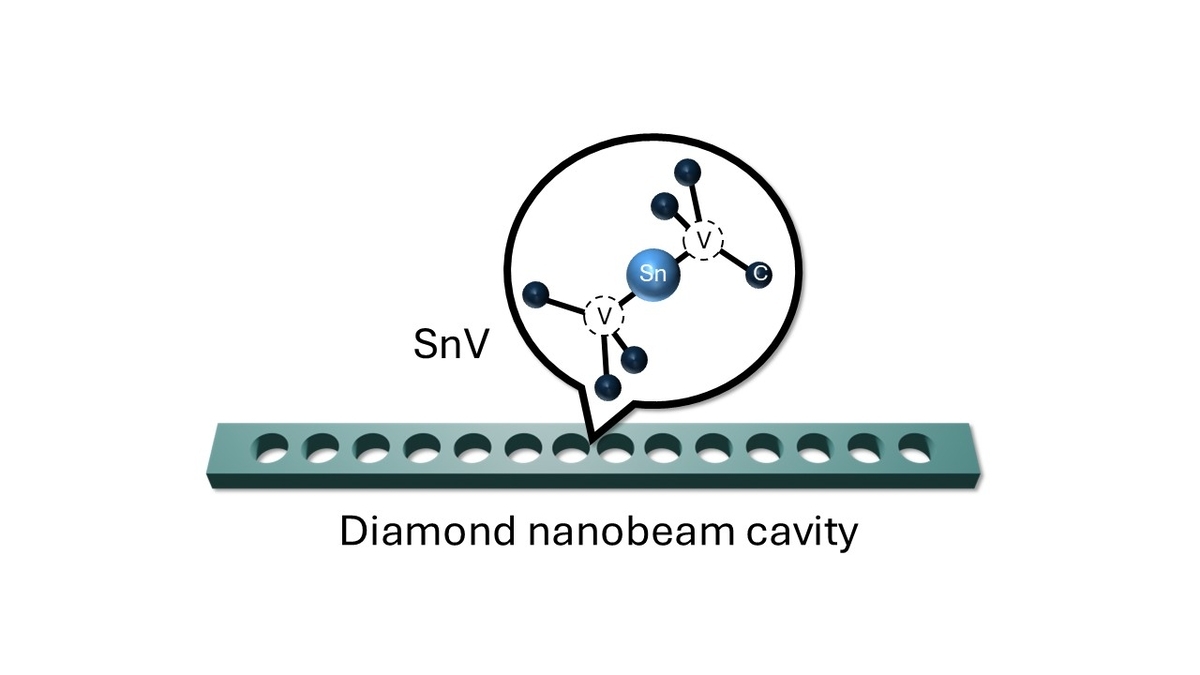
Color centers in diamond are considered promising candidates for stable qubit materials because, although they exist in a solid-state material, they can form quantum states resembling isolated atoms. Among them, the SnV center—created by replacing carbon atoms in the diamond lattice with a tin (Sn) atom and a vacancy—has recently attracted significant attention. Compared to the conventional NV center, it exhibits stronger zero-phonon-line emission between atomic energy levels, making it more suitable for quantum information processing.
An optical cavity is a device that confines light and consists of two highly reflective mirrors. Once light enters the cavity, it is repeatedly reflected, allowing it to remain trapped for a certain period. By placing a light‑interacting material inside such a cavity, the coupling between light and matter can be enhanced compared to the case without a cavity.
In this work, SnV centers are integrated with optical cavities in diamond nanodevices, and their optical properties are successfully improved. The optical cavity consists of a diamond nanobeam structure with a width and thickness on the order of a few hundred nanometers, in which periodic nanoscale holes are fabricated to create mirrors via refractive index modulation. The SnV centers are positioned at locations where the confined light is most strongly concentrated.
The improvement in optical properties due to the cavity effect can be quantified by how strongly light couples to the atomic system (in this case, the SnV center) before dissipating—this is referred to as cooperativity. Previous studies mainly demonstrated cavity effects in terms of energy dissipation of light. In such cases, while the introduction of an optical cavity enhances the brightness of color centers, its benefit for quantum networks remains limited. However, in this study, it was demonstrated that the optical properties of SnV centers can be enhanced by an optical cavity even when dephasing is taken into account as a source of dissipation (with the coherent cooperativity exceeding unity). This result indicates that the introduction of optical cavities can improve the entanglement generation rate between remote SnV nodes.
Scaling up quantum networks requires a large number of such devices. In this work, a total of 327 devices across two separate chips were evaluated, confirming sufficient manufacturability.
3. Future Outlook
The enhancement of SnV optical properties through the introduction of optical cavities is effective regardless of network distance and is directly applicable to improving the performance of modular quantum computing, where quantum modules are interconnected via short-range optical links to form a quantum computing chip. This technology is expected to become essential as the number of optically connected modules increases in the future. Continued advancement of the research and development of key technologies in diamond spin quantum systems is expected within this joint research project.
[1] https://www.fujitsu.com/global/about/resources/news/press-releases/2020/1013-02.html
[2] https://journals.aps.org/prx/abstract/10.1103/z514-v4n6
[3] https://qutech.nl/2026/06/25/a-step-toward-faster-quantum-networks/
