
Hello, we are the Graph AI team from the AI Lab at Fujitsu Research of Europe.
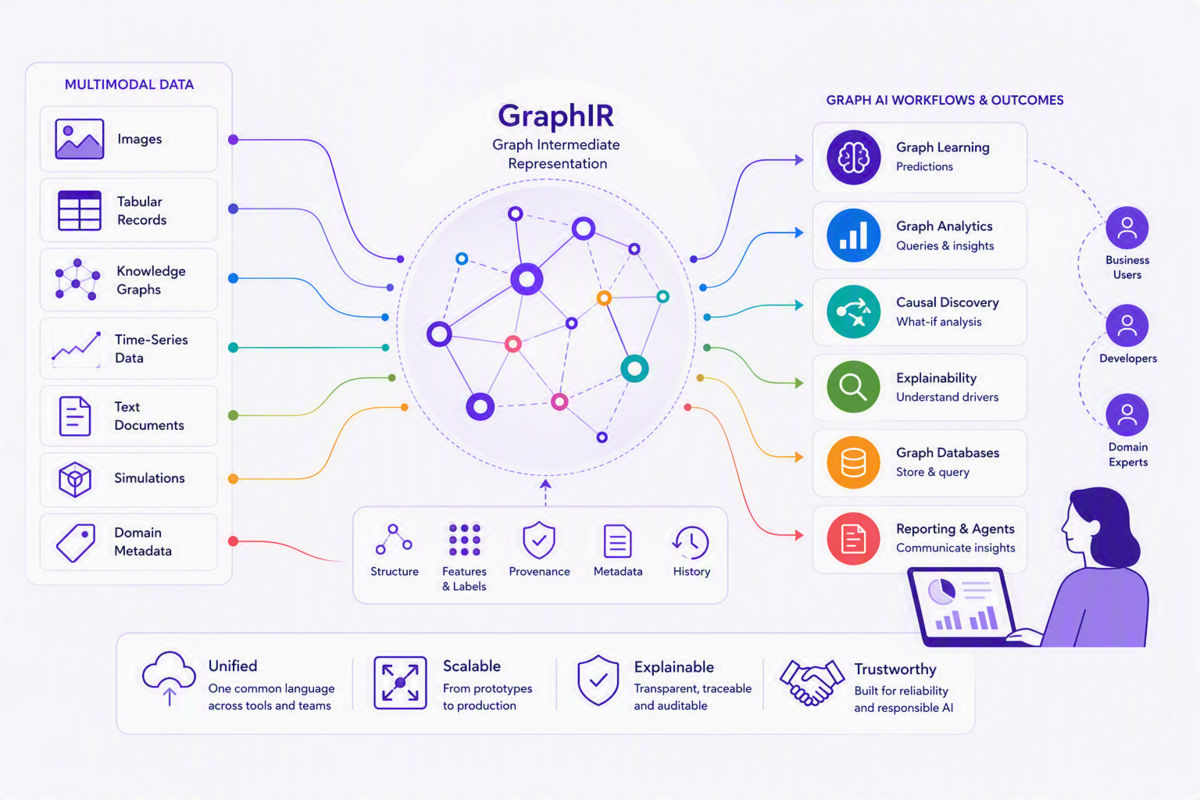
In many real-world AI projects, the most valuable information does not come in a single neat table or even a single source. It often comes from a variety of multimodal sources: images, tabular records, knowledge graphs, time-series data, simulations, text documents, and domain-specific metadata. Each source may be useful on its own, but the real value often comes from connecting them. The challenge is to meaningfully represent such complex interconnected data, build high-value AI workflows trained on it, and explain the resulting insights in a way that business users, developers, and domain experts can trust. To address this challenge, we are excited to introduce the first release of GNext, a reusable foundation for building the next generation of graph-based AI applications!
GNext is designed to help Fujitsu teams and partners build graph AI workflows more quickly, integrate capabilities from different research groups, and create applications that are easier to inspect, explain, and extend.
GNext provides a shared framework for turning complex multimodal data into graph representations, and for supporting a suite of graph-based tools to exchange data and perform downstream tasks. Diverse applications requiring tasks such as AI prediction, analytics queries, causal discovery, and reporting all become achievable within a unified, scalable, explainable, and trustworthy graph processing infrastructure. This first release is an important step towards a shared Fujitsu graph AI ecosystem.
Why We Built GNext
Many AI prototypes start from a specific dataset, a specific model, and a specific engineering stack. This can work well for a single demonstration, but it often makes reuse difficult. When a new project starts, teams may need to rebuild data converters, graph construction logic, model interfaces, visualisation tools, explainability components, and reporting workflows from scratch. Moreover, existing graph tooling all require their own data formats, reducing interoperability and enforcing hard boundaries between different parts of the engineering stack.
GNext addresses this by creating a reusable operating layer for graph AI tools. Instead of treating each application as a one-off pipeline, GNext provides common building blocks that can be reused across domains and improved by multiple contributors.
The goal is not to replace existing graph learning libraries, databases, or analytics tools. Instead, GNext aims to connect them through a shared graph representation and workflow framework.
GNext creates a single home for the wide variety of publicly available graph tools alongside proprietary Fujitsu technologies. At the same time, the intermediate representation ensures complete auditability of the data as it is transformed and analysed in the pipeline. This also means that new and unexpected synergies between tools are more likely to emerge – such as the use of graph analytics to interpret graph AI predictions and improve the automated reporting, or the use of causal discovery to aid the transformation of data into graphs!
The Core Idea: A Common Language for Graph AI Workflows
At the centre of GNext is the Graph Intermediate Representation, or GraphIR.
GraphIR gives GNext a shared way to describe graph structure, node and edge features, labels, provenance, metadata, and transformation history.
In practical terms, GraphIR allows different parts of a graph AI workflow to speak the same language.
The same graph can therefore become:
- an input for graph learning;
- a stored graph object for later reuse;
- a database-ready representation;
- an explanation target;
- an analytics object;
- an audit or provenance record;
- a component in a larger multimodal workflow.
This common representation is important because graph AI applications often involve many specialised components. A domain-specific converter may create the graph. A graph neural network may perform prediction. An explainability module may identify important nodes, edges, or concepts. A graph database may support traversal and querying. A reporting agent may help users understand the result.
Without a shared representation, these components remain disconnected. With GraphIR, they become part of a more coherent and reusable workflow.
What GNext Enables
GNext provides a common foundation for building scalable, explainable, and enterprise-ready graph AI applications while enabling teams to reuse and contribute capabilities across projects.
Multimodal Graph Construction
Convert diverse data sources such as images, tables, text, simulations, time-series, and knowledge graphs into a unified graph representation.
Graph Merging & Alignment
Combine and align graphs from different modalities, enabling richer, more connected AI applications.
Explainability & Inspection
Trace predictions back to supporting graph evidence, helping users understand why a result was produced.
Analytics & Querying
Go beyond prediction with graph exploration, relationship analysis, querying, visualisation, and evidence tracing.
Provenance & Trust
Track data transformations, metadata, and workflow history to support transparency, auditability, and trustworthy AI.
Extensible Contributor Ecosystem
Add new converters, algorithms, adapters, visualisation tools, optimisation modules, agents, and applications through a shared framework.
Why This Matters for Business and Research Teams
GNext is valuable because it turns graph AI from a set of isolated tools into a reusable capability.
For research teams, it provides a shared framework for integrating different graph technologies and demonstrating them in realistic workflows.
For development teams, it provides reusable components that can reduce duplicated engineering effort and accelerate prototype-to-demo cycles.
For customer-facing teams, it provides a stronger technology story: Fujitsu can bring together state-of-the-art graph capabilities as part of a connected platform and thereby build AI systems that are not only predictive, but also inspectable, explainable, and easier for regulated industries to govern.
In short, GNext helps graph AI capabilities become more reusable, more trustworthy, and easier to apply across domains.
Use Case 1: Explainable Intelligence from Satellite Images
One of the first GNext demonstrations focuses on land-cover classification using multimodal satellite imagery. The dataset is SEN12MS containing over 180K multimodal satellite image patches.
In this workflow, different satellite modalities such as radar, visible imagery, and infrared bands of the same region are converted into graph representations. GNext then brings these graph views together so that a model can perform prediction while still allowing users to inspect the underlying graph structure.
This changes the user experience from a black-box classification task into an inspectable graph workflow. Users can see how multiple sources contribute to a prediction, explore graph structures behind the decision, look at supporting literature to justify the predictions, and connect model evidence back to nodes, edges, and image regions.
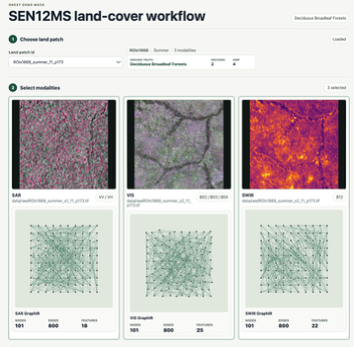
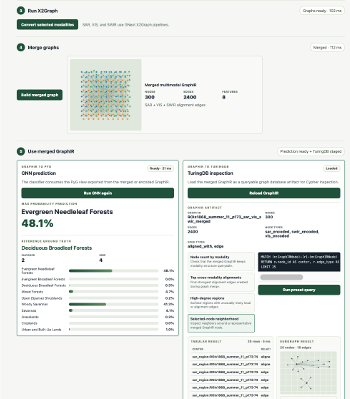
The same task is also demonstrated through two interface options.
The first shown above is a web-based user interface where users can inspect the workflow and visualise the result interactively. The second shown below is an LLM-based Discovery Agent that exposes the same core functionality through a modular multi-agent UI framework. This agentic interface can combine graph evidence with external context sources, such as web search or knowledge graphs, to support richer explanation and interpretation.
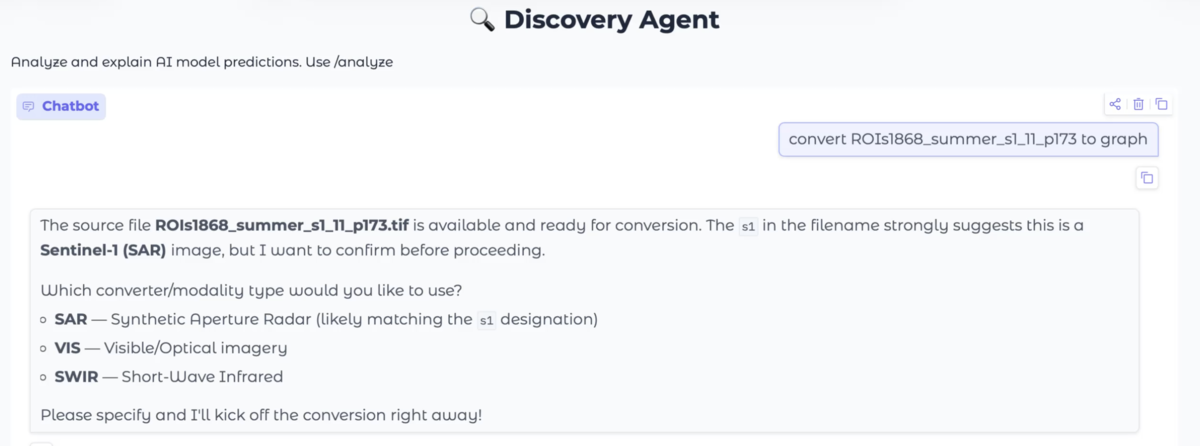
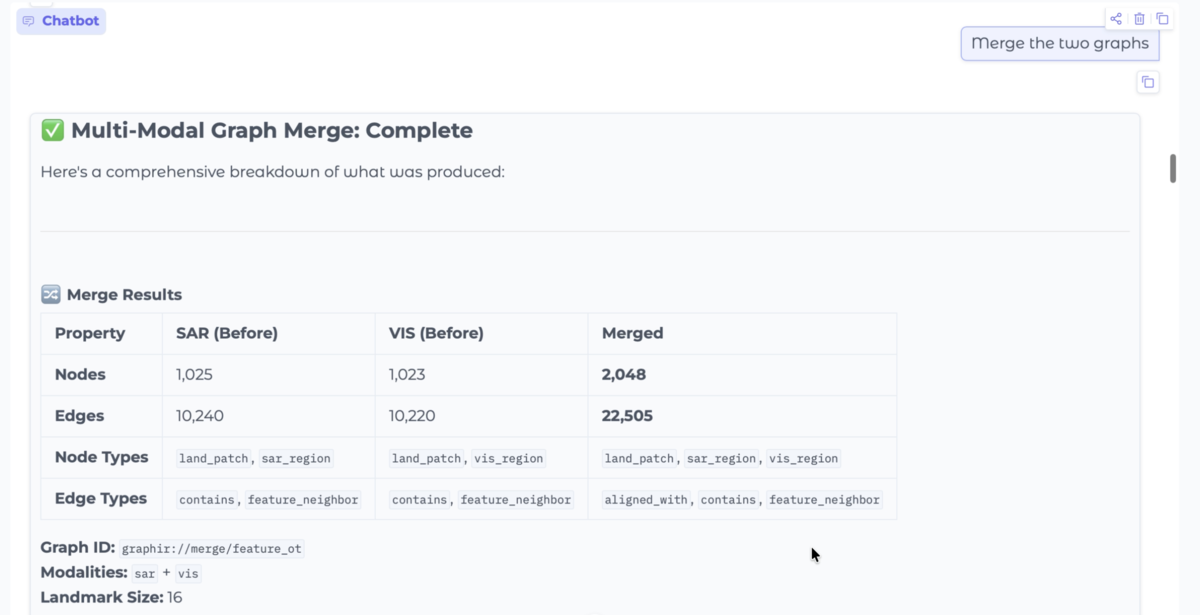
This makes the remote sensing demo a strong example of how GNext can support explainable AI for environmental monitoring, geospatial intelligence, infrastructure inspection, and other image-based use cases.
Use Case 2: Personalised Medicine using Multimodal Healthcare Data
Healthcare is another important application area for GNext because patient understanding often depends on multiple data modalities.
In the current healthcare demonstration, GNext is applied to breast cancer subtyping using tumour biopsy images, genomic data, and clinical information all obtained from the patient. Each modality can be transformed into a graph representation, after which the resulting graphs can be aligned or merged into a multimodal digital twin representation of the patient. The demo uses public TCGA BRCA data from around 1000 patients. Our graph approach helps reduce the memory requirement of histopathology slide images (over 1.5TB) by several orders of magnitude, needing less than 1MB per spatial image graph.
A healthcare patient’s tumour images, genetic and molecular information, clinical records, etc do not naturally align in a direct way. Instead, modality-specific graph converters and representation learning methods are needed to infer similarities and connect different views of the same patient.
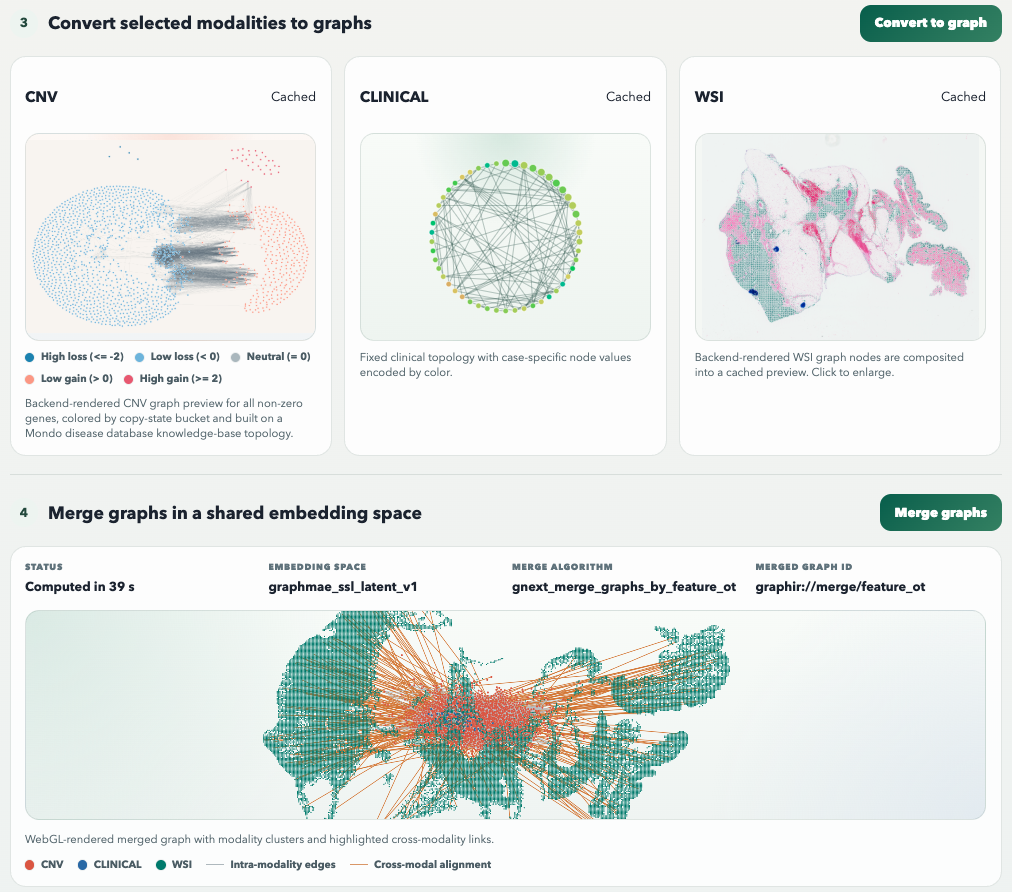
GNext provides a framework for organising this complexity. It allows heterogeneous patient data to become a connected and inspectable representation that can support prediction, analytics, and explanation. Biomedical knowledge graphs can also be represented as multilayer heterogeneous graphs. This opens the door to cohort-level analytics, semantic retrieval, graph traversal, and explainable insights that connect individual measured information samples with established expert domain knowledge and context. For example, the genomic information contains 20K gene features per patient, but the external knowledge can help us filter this to a smaller set of 1K highly relevant genes.
In this way, GNext can help bridge the gap between multimodal biomedical data and trustworthy AI-supported clinical research workflows.
Use Case 3: Financial Fraud Detection with Insights
Fraud detection is a natural graph AI problem because relationships matter.
Fraud signals may emerge from connections between individuals, companies, transactions, ownership structures, representatives, consultants, sales relationships, or repeated behavioural patterns. These signals are often difficult to detect when each record is analysed independently. The financial fraud detection application has been successfully demonstrated on graphs such as T-Finance, Elliptic Bitcoin, WikiCS, and TAG-Cora, which range from 10K to 200K node entities, and 20K to 20M edge connections.
The technical challenge is also severe. Fraud cases are rare, detected in less than 1% of entities in million-scale graph datasets! Moreover, labels may be noisy and suspicious behaviour may be deliberately designed to look normal, leading to mislabeled data. For this reason, the GNext financial fraud workflow combines graph neural network prediction with noisy-label detection and explainability.
The explainability component is especially important. Analysts need more than a risk score. They need to understand what patterns are considered suspicious, what relationships contributed to the result, and whether the evidence is meaningful enough to support investigation.
GNext supports this by allowing prediction, explanation, and analytics to be integrated in the same graph-based workflow. This can help analysts prioritise cases, inspect evidence paths, and build greater confidence in AI-assisted decisions.
A Platform for Contributors – Get Involved!
The first release is only the beginning. This is the starting point for a shared Fujitsu graph AI ecosystem.
We are looking for contributors and early users who want to help shape the next releases. Whether you are building graph tools or generic modules, GNext gives you a place to make your tools reusable across projects and connect your contribution with others.
If you are building customer-facing applications, GNext can help you assemble graph workflows without starting from scratch.
We invite Fujitsu researchers, developers, solution teams, and development partners to explore GNext and contribute to the growing graph AI ecosystem.
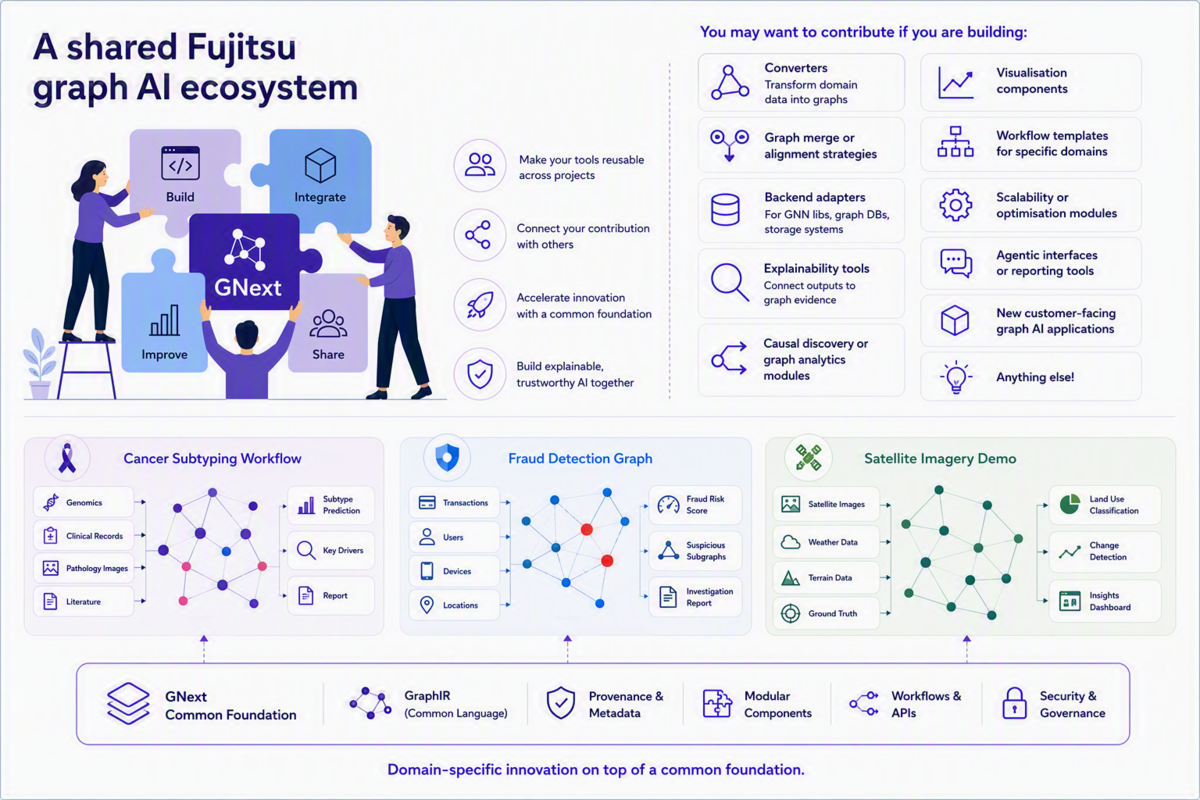
That is the central promise of GNext: domain-specific innovation on top of a common foundation.
Internal Links for Contributors
- GNext repository:
https://code.mahitahi.global.fujitsu.com/fj-graph/gnext
- Remote-sensing demo repository:
https://code.mahitahi.global.fujitsu.com/fj-graph/gnext-demo
- Discovery Agent demo repository:
https://code.mahitahi.global.fujitsu.com/fj-graph/discovery-agent
Contact
Mohammed Amer (Senior Researcher, Graph AI @ AI Lab, FRE) mohammed.amer@fujitsu.com
Aparajita Haldar (Senior Research Manager, Graph AI @ AI Lab, FRE) aparajita.haldar@fujitsu.com
